
J-Beauty vs. K-Beauty: Why Japan's 'Mochi Skin' & Minimalist Science Might Be India's Next Obsession

Introduction:
While Korean beauty (K-Beauty) has dominated global beauty consciousness for the past decade—with 10-step skincare routines, sheet masks, BB creams, and innovative actives becoming household references—a quieter, equally sophisticated beauty philosophy has maintained steady influence among skincare professionals and beauty insiders: Japanese beauty (J-Beauty), representing an entirely different approach to skincare excellence. Where K-Beauty emphasizes visible technological innovation, multi-step complexity, and aggressive pursuit of perfection, J-Beauty prioritizes subtle efficiency, minimalist formulation philosophy, and pursuing "mochi skin"—a distinctly Japanese aesthetic celebrating plump, soft, luminous complexion resembling the beloved mochi dessert rather than the poreless perfection K-Beauty pursues.
The philosophical divide between these two major Asian beauty movements reflects deeper cultural differences: K-Beauty emerged from rapid industrialization, technological advancement, and competitive beauty market dynamics driving innovation and visible results; J-Beauty developed from centuries of refined aesthetics, philosophical restraint, and belief that true beauty emerges through simplicity rather than complexity.
This comprehensive analysis explores fundamental J-Beauty vs. K-Beauty differences, explains the mochi skin aesthetic and its scientific foundations, examines minimalist skincare science revolutionizing efficacy approaches, and demonstrates why J-Beauty philosophy increasingly captivates Indian beauty consumers seeking sustainable, results-driven approaches aligned with individual skin wellness rather than conformity to extreme beauty standards.
The Philosophical Foundations: Where K-Beauty and J-Beauty Diverge:
Understanding J-Beauty versus K-Beauty requires examining the cultural and philosophical foundations generating their distinctly different approaches to skincare excellence. These differences extend far beyond product selection or routine complexity; they reflect fundamental worldviews about beauty, perfection, and human interaction with natural processes.
K-Beauty Philosophy emerged from rapid industrialization transforming South Korea into a global technology leader. This context generated a beauty culture celebrating innovation, visible results, and technological advancement. The "glass skin" aesthetic—flawless, poreless, glowing complexion—represents K-Beauty's ultimate ideal, achievable through meticulous multi-step routines, targeted activities addressing specific concerns, and consistent investment of time and resources. K-Beauty embraces visible skincare excellence as status marker and self-care expression; the elaborate routine itself becomes valued achievement rather than means to end. This philosophy has generated extraordinary innovation: fermentation technologies, innovative activities, sheet mask evolution, and countless formulation breakthroughs emerging from Korean laboratories.
J-Beauty Philosophy reflects centuries of Japanese aesthetic tradition emphasizing "wabi-sabi"—finding beauty in imperfection, impermanence, and simplicity. Rather than pursuing flawless perfection, J-Beauty celebrates subtle beauty emerging through restraint and refinement. The philosophy views skincare not as competitive pursuit but as meditative self-care ritual; the minimalist routine itself becomes contemplative practice rather than demanding obligation. J-Beauty believes true skin health emerges from respecting natural skin processes rather than constantly intervening through treatments. This restraint produces a paradoxical result: by using fewer products yet selecting them with extraordinary precision, J-Beauty achieves skin quality often surpassing K-Beauty's more complex approaches.
The K-Beauty Approach: Multi-Step Mastery and Visible Results:
K-Beauty's worldwide dominance stems from genuine innovation producing measurable results and democratizing access to advanced skincare. The iconic 10-step routine emerged not arbitrarily but through addressing specific skin concerns through targeted formulations, each step building upon previous ones to create a comprehensive treatment protocol.
The K-Beauty Routine Structure:
- Oil cleanser – removes makeup and oil-soluble impurities.
- Water-based cleanser – removes water-based residue and deeply cleans skin.
- Gentle exfoliant – clears dead cells and boosts penetration of later products.
- Hydrating toner – replenishes moisture and preps skin.
- Essence – delivers lightweight, concentrated actives for hydration and repair.
- Serum/ampoule – targets focused issues like pigmentation, aging, or acne.
- Sheet mask – provides intensive, short-term treatment and deep hydration.
- Eye cream – treats the delicate under-eye area (dark circles, fine lines, puffiness).
- Moisturizer – seals in hydration and supports the skin barrier.
- Sleeping mask (optional) – gives an overnight treatment boost.
- This structure follows a logical progression from cleansing → prepping → treating → sealing, so every product can work more effectively and multiple concerns are addressed at once.
- Users often report clear, visible results with consistent K-Beauty routines: reduced hyperpigmentation, smoother texture, more glow, smaller-looking pores, and better firmness and bounce.
- K-Beauty formulas frequently include high levels of actives, fermented ingredients for better absorption, and treatment-focused masks, making them more performance-driven than many traditional products.
- Key challenges: a full 10-step routine takes 20–30 minutes daily and can be hard to sustain for busy people.
- Layering many products increases the risk of irritation, especially for sensitive skin, due to ingredient overload or incompatible combinations.
The J-Beauty Approach: Minimalist Mastery and Mochi Skin:
- J‑Beauty focuses on fewer, carefully chosen products with elegant, high-quality formulations that maximize each ingredient’s efficacy and celebrate naturally healthy skin, not heavy coverage.
- Mochi skin is J‑Beauty’s ideal: skin that looks plump, soft, bouncy, luminous, and delicate—like the texture and appearance of mochi.
- Unlike K‑Beauty’s “poreless perfection,” mochi skin accepts subtle texture and emphasizes hydration, inner radiance, and healthy vitality over obvious makeup.
- It requires deep, lasting hydration, a strong barrier, refined glow that looks like it comes from within, and minimal visible cosmetic intervention.
- The J‑Beauty routine structure is intentionally minimalist:
- Gentle cleanser – removes impurities without stripping the barrier.
- Hydrating toner – replenishes moisture and preps the skin.
- Essence or serum – delivers focused, concentrated benefits (hydration, brightening, anti‑ageing).
- Moisturizer – seals in hydration and supports the barrier.
- Optional targeted treatment – spot care (pigmentation, acne, sensitivity) only if needed.
- This streamlined routine usually takes 5–10 minutes, making it realistic to maintain consistently over years and decades.
- The simplicity helps prevent over‑exfoliation and irritation because the skin is not bombarded with multiple overlapping activities and layers.
- Key strengths of J‑Beauty:
- Sustainable long‑term efficacy through consistency and low routine fatigue.
- Lower cost than 8–10 step routines because fewer products are used.
- Better tolerance for sensitive or barrier‑impaired skin due to minimal layering and gentle formulas.
- Emphasis on holistic health—sleep, stress, diet, and lifestyle are treated as essential parts of achieving mochi skin, not just topical products.
- Philosophically, J‑Beauty trusts the skin’s natural self‑regulation, intervening only with what is truly necessary: cleanse, hydrate, protect, and selectively treat.
- By avoiding constant heavy intervention and allowing skin processes to function normally, J‑Beauty aims for gradual, compounding improvement, where skin is genuinely healthier—not just temporarily “perfected” by coverage.
Mochi Skin vs. Glass Skin: Understanding the Aesthetic Difference: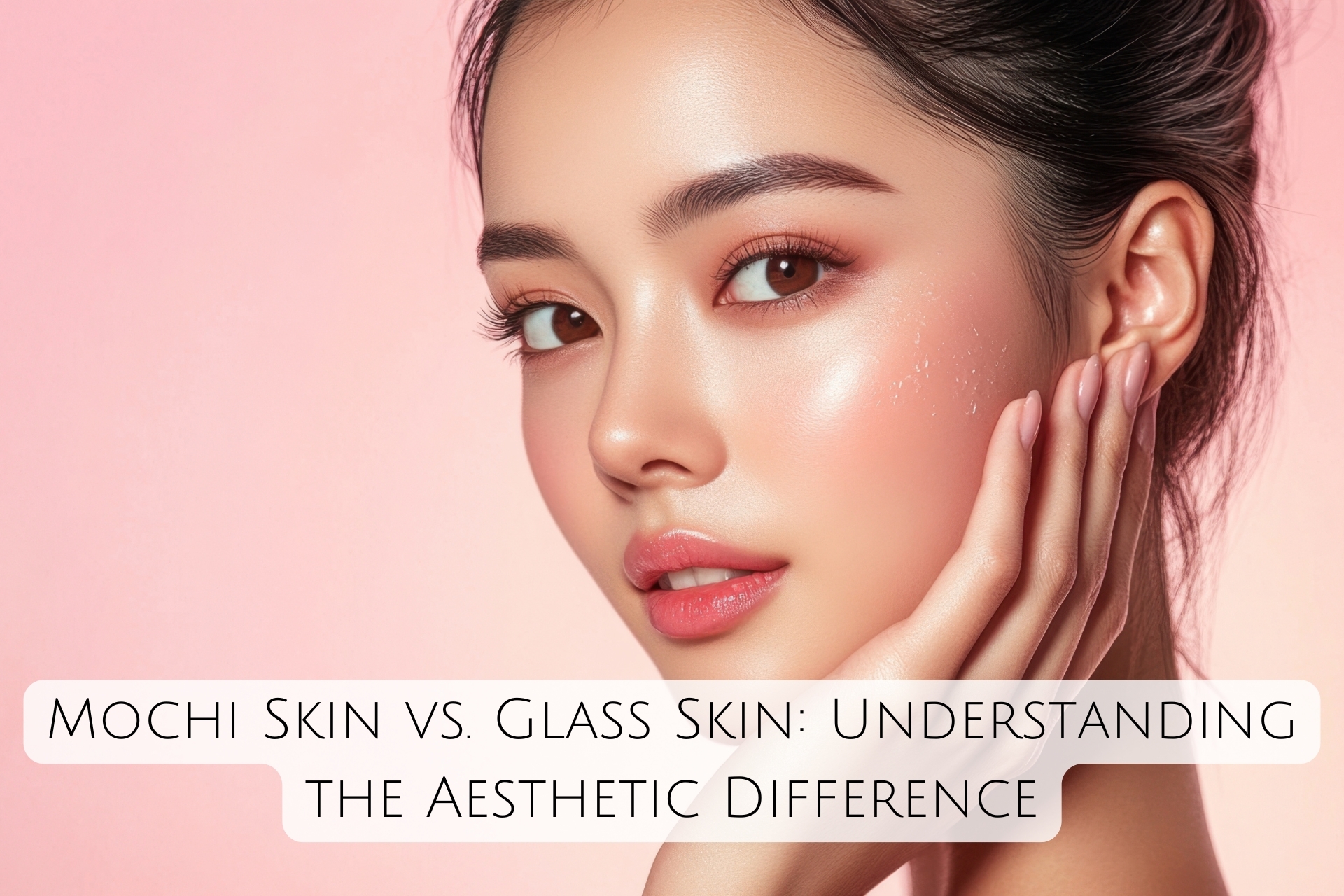
The distinction between mochi skin and glass skin reveals fundamental differences in J-Beauty and K-Beauty aesthetics, each reflecting different values and priorities.
Glass Skin (K-Beauty Ideal): This aesthetic emphasizes flawless appearance resembling polished glass—perfectly even tone, zero visible imperfections, poreless appearance, and overall impression of artificial perfection. Achieving glass skin typically requires full-coverage foundation, concealer addressing any imperfection, and overall makeup application creating smooth, polished appearance. While undeniably striking, glass skin requires significant daily makeup application and constant imperfection management; once makeup removes, glass skin disappears. Glass skin prioritizes external appearance over internal skin health; it celebrates achievement of perfect coverage rather than optimal skin condition.
Mochi Skin (J-Beauty Ideal): This aesthetic celebrates plump, soft, luminous complexion appearing healthy and youthful without obvious cosmetic application. Mochi skin features subtle texture, natural luminosity, delicate appearance, and overall impression of genuine health and vitality. Achieving mochi skin requires consistent skincare prioritizing hydration, barrier support, and internal wellness; it's achieved through skin health rather than makeup coverage. Mochi skin appears more "real" than glass skin—visible skin texture, natural luminosity, subtle imperfections accepted as part of authentic beauty. However, mochi skin proves more sustainable; it persists whether or not makeup is applied, as it emerges from genuine skin quality rather than cosmetic coverage.
Minimalist Science: How J-Beauty Achieves Maximum Results Through Minimal Products:
J-Beauty's efficacy emerges from sophisticated understanding of dermatology and ingredient science applied toward minimalist formulation philosophy. Rather than assuming more products equal better results, J-Beauty research demonstrates that precisely selected, highly effective formulations often deliver superior outcomes through enabling skin to process and benefit fully from each product.
-
Ingredient Synergy Over Ingredient Quantity:

K-Beauty combines multiple activities addressing various concerns simultaneously; J-Beauty selects single-purpose formulations featuring ingredient combinations amplifying efficacy without introducing incompatibilities. For example, rather than combining brightening, anti-aging, and hydrating actives in single serum, J-Beauty develops separate serums: one optimized for brightening through specific botanical concentration; another for anti-aging through peptide or retinol formulation; another for hydration through humectant technology. This targeted approach enables each formulation to optimize ingredient concentration and complementary supporting ingredients specifically suited to the primary goal.
-
Bioavailability Optimization:
J-Beauty prioritizes enabling ingredient penetration and skin absorption over achieving maximum visible concentration. Rather than loading products with ingredient quantity, J-Beauty invests in delivery technologies, pH optimization, and complementary ingredients enhancing absorption and efficacy of primary actives. This results in formulations with smaller ingredient quantities yet superior results compared to formulations with higher concentrations poorly absorbed by skin.
-
Skin Barrier Respect:
K-Beauty's multi-step routines occasionally overwhelm skin barrier through constant product exposure; J-Beauty's minimalist approach reduces barrier stress, enabling skin to maintain optimal function. Healthy barriers naturally become hydrated, luminous, and resistant to irritation—supporting mochi skin aesthetic perfectly.
-
Botanical Intelligence:

J-Beauty emphasizes time-tested botanical ingredients refined through centuries of Japanese traditional practice. Rather than pursuing cutting-edge activities, J-Beauty focuses on ingredients with documented efficacy and excellent safety profiles. Common J-Beauty botanicals include sakura extract (brightening and anti-inflammatory), green tea (antioxidant and sebum-regulating), and Japanese white flower extract (delicate and soothing). These ingredients deliver proven benefits with minimal irritation potential—particularly valuable for sensitive skin populations.
Why India Might Embrace J-Beauty: Cultural and Practical Alignment: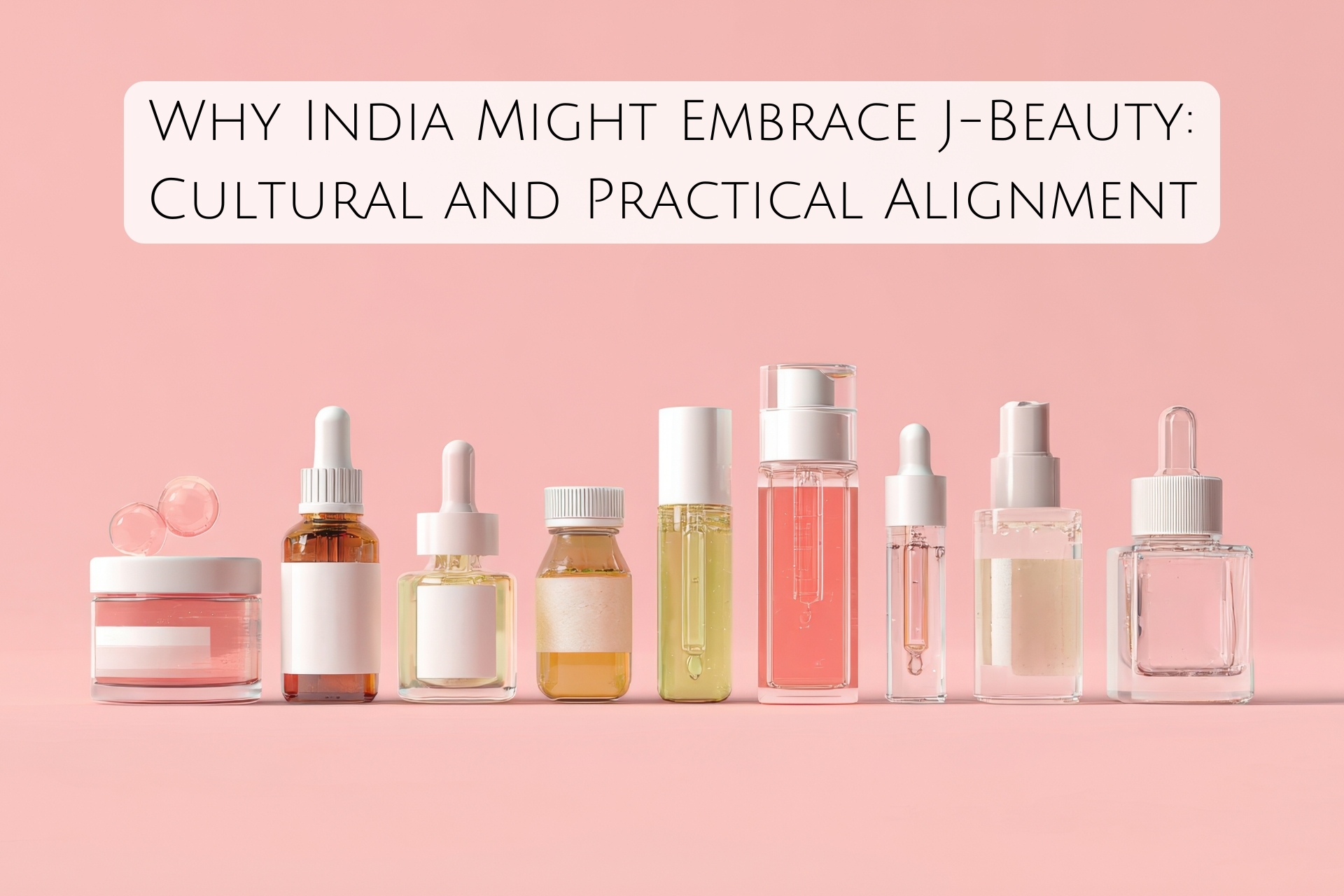
Indian beauty consumers increasingly discovering J-Beauty philosophy find remarkable alignment with traditional Indian values, practical lifestyle constraints, and emerging wellness priorities.
-
Alignment with Traditional Indian Philosophy:
Indian beauty traditions, like Japanese aesthetics, value subtle enhancement over dramatic transformation. Ayurvedic beauty philosophies emphasize prevention, internal wellness, and balanced approaches—concepts strikingly similar to J-Beauty philosophy. The minimalist approach aligns naturally with Indian values of sustainability and resource consciousness. Additionally, Indian preferences for natural ingredients, botanicals, and traditional formulations resonate with J-Beauty's emphasis on time-tested ingredients.
-
Climate and Skin Considerations:
India's tropical climate, high humidity, and intense sun exposure frequently challenge skin; heavy multi-step routines contribute to congestion, irritation, and barrier disruption in humid conditions. J-Beauty's minimalist approach proves particularly suited to the Indian climate; fewer products prevent excess buildup while lightweight formulations work beautifully in humidity.
-
Professional and Social Context:
Indian professionals, particularly in conservative sectors, navigate beauty standards similar to Japan's: understated elegance proves more career-advancing than dramatic makeup. J-Beauty's aesthetic aligns perfectly with professional environments where obvious cosmetic application risks judgment.
-
Wellness Prioritization:
Indian consumers increasingly prioritize wellness alongside beauty; J-Beauty's holistic philosophy emphasizing sleep, stress, and nutrition alongside skincare resonates with this shift. The minimalist approach supports wellness by reducing daily stress through simplified routines while enabling investment of time and energy toward health-supporting activities.
Kiwla's Role: Bringing J-Beauty Excellence to Indian Consumers:
When seeking premium J-Beauty products featuring the minimalist science that makes Japanese skincare extraordinary, Kiwla emerges as your essential gateway to authentic Japanese beauty formulations previously unavailable in India. Kiwla specializes in carefully curating the finest J-Beauty brands—from legendary Japanese skincare institutions like Shiseido and SK-II to emerging Japanese beauty innovators crafting next-generation minimalist formulations. What differentiates Kiwla is their profound understanding that J-Beauty represents a philosophy, not merely a product category. Their carefully curated selection showcases brands embodying J-Beauty's core principles: minimalism without compromise, scientific sophistication in service of simplicity, respect for skin barrier health, and reliance on time-tested ingredients validated by modern science.
Kiwla fundamentally transforms J-Beauty accessibility for Indian consumers by providing authenticated Japanese products, expert guidance, and reliable delivery enabling confident minimalist skincare adoption. Previously, discovering genuine J-Beauty required navigating unfamiliar Japanese e-commerce platforms, managing language barriers, and accepting international shipping delays. Beyond product provision, Kiwla's blog content exploring J-Beauty philosophy, mochi skin achievement, and minimalist skincare science supports informed aesthetic choices. Rather than blindly adopting K-Beauty's demanding routines or pursuing glass skin perfection, consumers understand J-Beauty's philosophical foundations, can evaluate whether minimalist approaches suit personal preferences and lifestyles, and can confidently implement routines aligned with values.
Conclusion:
The comparison between J-Beauty and K-Beauty ultimately reveals that the beauty industry's emphasis on complexity, multiple products, and elaborate routines may serve commercial interests more than consumer wellbeing. Korean Beauty's legitimate innovations and impressive results become obscured by the industry's profit motive to convince consumers that more products, higher costs, and greater complexity equal superior outcomes. Japanese Beauty challenges this narrative not through dismissing innovation but by asking whether innovation serves skin health or merely drives consumption.
For anyone questioning whether their elaborate skincare routine is necessary, feeling guilty about skincare time commitments, or experiencing skin sensitivity despite diligent routine adherence, J-Beauty offers liberation through simplification. Through Kiwla, accessing authentic Japanese formulations and understanding the philosophy behind minimalist science has never been more accessible. The mochi skin revolution isn't about following another trend but about embracing a philosophy suggesting that beautiful, healthy skin emerges from respecting skin's nature rather than fighting it. Your skincare journey might be as simple as cleansing, hydrating, and sealing—the timeless foundation of Japanese beauty approaching skincare with elegance, science, and profound respect for skin's intrinsic capability to radiate health and beauty.
Recent Posts
-
From K-Beauty to Desi Beauty: How Korean Skincare Trends Are Shaping India’s Routine
Introduction: Korean skincare, popularly known as K-Beauty, has taken the global beauty world by sto
-

Health-span vs Life-span: What Does ‘Living Better’ Really Mean?
Introduction: Defining Health-span and Life-span In the world of healthcare and wellness, the concep
-
Redefining Anti-Aging: Modern Strategies for Sustained Youth & Vitality
Introduction: For decades, the beauty industry focused on concealing the visible signs of aging—wrin