
"THIRD-PARTY TESTED": WHAT NSF, USP, AND INFORMED SPORT ACTUALLY VERIFY
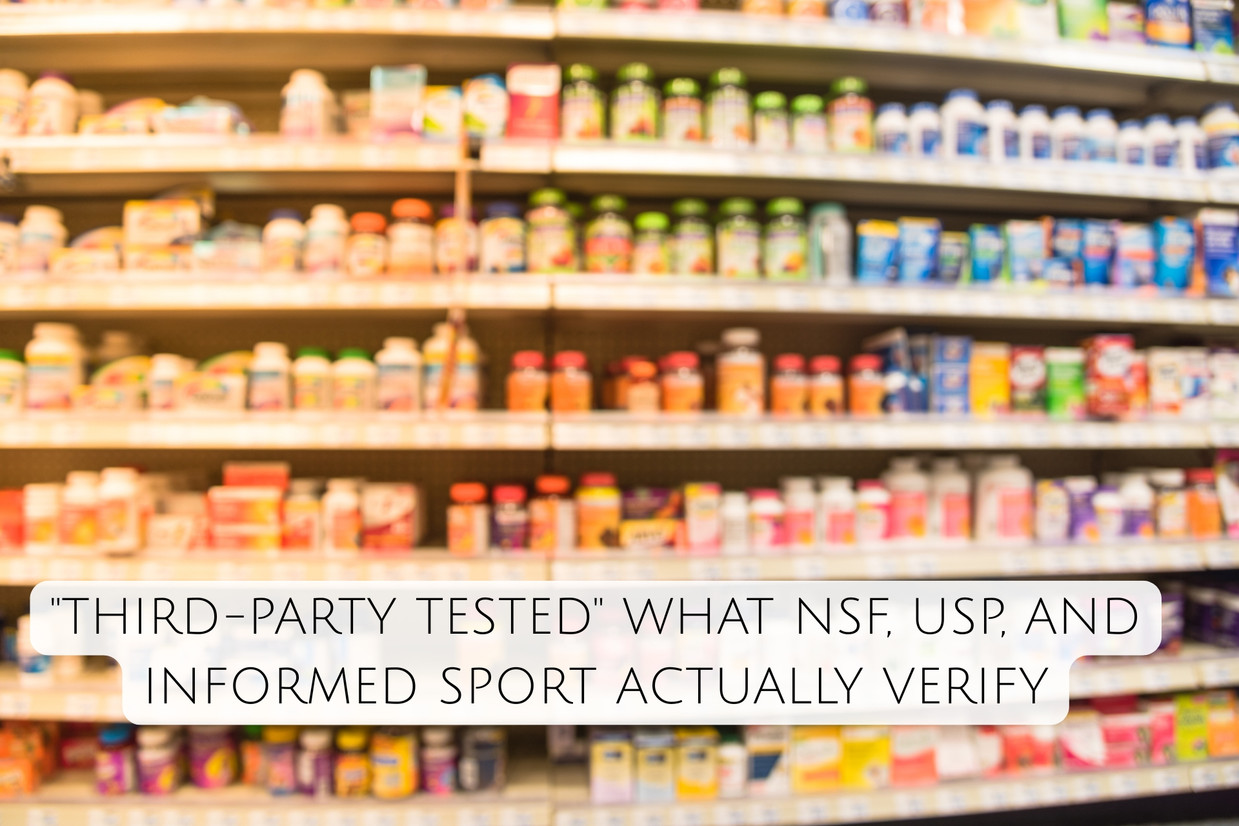
You've seen the little badges on supplement bottles — NSF, USP, Informed Sport — sitting there looking official, printed in a font that suggests trustworthiness. But what does third-party tested supplements actually mean when you flip the bottle over and see one of these logos? Most people assume it means "the FDA checked this," and that assumption is exactly where the confusion starts.
None of these three certifications are government regulators. They're independent organizations that test supplements against specific standards, and each one verifies something meaningfully different. This breaks down exactly what NSF, USP, and Informed Sport check for, what gaps remain even with their seal on the bottle, and why this matters if you're importing or buying international supplements into India.
QUICK ANSWER / Third-party tested supplements carry a seal from an independent lab — NSF, USP, or Informed Sport — verifying label accuracy, ingredient purity, or the absence of banned substances. These certifications don't confirm a supplement actually works; they confirm what's on the label matches what's in the bottle, and that it's free from specific contaminants.
WHY THIRD-PARTY TESTED SUPPLEMENTS CERTIFICATIONS EXIST AT ALL?
In the United States, dietary supplements are regulated under DSHEA, a framework that treats supplements more like food than medication. The FDA doesn't approve supplements before they reach shelves the way it approves prescription drugs.
That regulatory gap is exactly why third-party testing organizations exist. Manufacturers pay for independent verification specifically because government oversight happens mostly after a product is already on the market, usually only in response to a reported problem.
This isn't unique to supplements sold in America. Similar gaps exist in many markets, including India, where FSSAI oversight has strengthened considerably but still doesn't match the pre-market scrutiny applied to pharmaceuticals. Third-party certification fills a comparable role wherever that gap exists.
These seals exist to fill a gap the FDA doesn't close before a product ever reaches a shelf.
WHAT NSF CERTIFICATION ACTUALLY VERIFIES:
NSF Certified for Sport: The Gold Standard for Athletes:
NSF International runs one of the most rigorous supplement certification programs available, and its "Certified for Sport" mark specifically targets a very defined problem: banned substance contamination.
- Banned substance screening: NSF tests each certified batch against the substance lists maintained by major sporting bodies, including the World Anti-Doping Agency and professional leagues.
- Label accuracy verification: NSF confirms that the ingredient amounts printed on the label match what's actually present in the product, batch by batch, not just at initial certification.
- Manufacturing facility audits: Certified facilities undergo regular unannounced inspections, checking for cross-contamination risks and manufacturing consistency.
What NSF Certification Doesn't Confirm:
- Effectiveness: NSF certification says nothing about whether an ingredient at the labeled dose actually produces the claimed benefit — that's a separate question entirely from purity and accuracy.
- Safety for every individual: Certification confirms the product matches its label and avoids specific contaminants, not that it's appropriate for every health condition or medication interaction.
NSF also runs a broader "NSF Contents Certified" and general supplement certification program beyond the Sport-specific mark, which is worth distinguishing since the Sport version carries the more rigorous banned-substance screening most athletes specifically need.
WHAT USP VERIFICATION ACTUALLY VERIFIES:
USP's Focus: Purity, Potency, and Manufacturing Quality:
The United States Pharmacopeia has a much longer history than most supplement-specific certifiers, originally built around pharmaceutical quality standards before extending into dietary supplements.
- Ingredient identity confirmation: USP verifies that a supplement actually contains the specific ingredient claimed, not a substitute or filler passed off under the same name.
- Potency within stated range: USP checks that active ingredient levels fall within an acceptable range of the labeled amount, rather than being significantly under- or over-dosed.
- Contaminant limits: Testing includes screening for heavy metals, pesticides, and microbial contamination against USP's own established limits.
- Dissolution testing: USP verifies that a tablet or capsule actually breaks down properly in the body within an appropriate timeframe, which affects whether the ingredients get absorbed at all.
What USP Verification Doesn't Confirm:
USP verification doesn't screen for the specific athletic banned-substance lists that NSF Certified for Sport checks — it's a quality and purity standard, not an anti-doping standard, which matters if you're specifically an athlete subject to testing.
WHAT INFORMED SPORT ACTUALLY VERIFIES:
Built Specifically for Competitive Athletes:
Informed Sport, run by LGC in the UK, exists almost entirely to solve the doping contamination problem for competitive and professional athletes, with a narrower but very deep focus compared to NSF or USP.
- Batch-by-batch testing: Unlike some certifications that test periodically, Informed Sport requires every single batch to be tested before it ships, offering a higher testing frequency than many alternatives.
- Extensive banned substance panel: The testing panel covers a very wide range of prohibited substances relevant to Olympic and professional sport, updated as banned substance lists change.
- Supply chain auditing: Informed Sport also audits raw ingredient suppliers, not just the final manufacturing facility, catching contamination risks earlier in the production chain.
What Informed Sport Doesn't Confirm:
Like NSF, Informed Sport's certification doesn't verify that a supplement's active ingredients work as claimed — its entire focus is contamination and banned substance risk, not efficacy.
NSF VS USP VS INFORMED SPORT: THE REAL DIFFERENCES
- Primary focus: NSF and Informed Sport center on banned substance screening for athletes; USP centers more broadly on purity, potency, and manufacturing quality for general consumers.
- Testing frequency: Informed Sport's batch-by-batch requirement is generally the most frequent; NSF and USP typically test at set intervals rather than every single batch.
- Best fit for competitive athletes: NSF Certified for Sport or Informed Sport, given their specific anti-doping focus and recognition by major sporting organizations.
- Best fit for general supplement quality: USP Verified, given its broader purity and potency standards relevant to any consumer, athlete or not.
WHAT THIS MEANS FOR INDIAN CONSUMERS BUYING IMPORTED SUPPLEMENTS:
A growing number of Indian consumers order supplements directly from US or UK retailers, or buy imported stock through local resellers, and these certification marks become genuinely relevant in that context.
India's own supplement regulatory framework under FSSAI has tightened in recent years, but third-party marks like NSF, USP, and Informed Sport still offer an additional, internationally recognized layer of verification that's worth checking specifically on imported products.
- Check for the mark, not just the brand name: A well-known international brand doesn't automatically mean every product line carries third-party certification — check the specific product, not just the company.
- Verify through the certifier's database: All three organizations maintain searchable online databases of certified products, which is the most reliable way to confirm a certification claim is current and genuine.
- Understand shipping and storage risks: Certification applies at the point of manufacturing and testing — improper storage or shipping conditions during import to India's heat and humidity can still degrade a product after the fact.
COMMON QUESTIONS ABOUT THIRD-PARTY SUPPLEMENT TESTING:
Does a third-party seal mean the FDA has approved the supplement?
No. The FDA doesn't pre-approve dietary supplements the way it approves medications. Third-party certifications like NSF, USP, and Informed Sport are entirely separate from FDA oversight, run by independent organizations rather than government regulators.
Can a supplement be high quality without any certification at all?
Yes, certification is voluntary and costs manufacturers real money, so plenty of genuinely well-made products skip it, particularly smaller or newer brands. The absence of a seal isn't automatically a red flag, but its presence does provide independently verified assurance that self-reported quality claims don't offer.
Is one certification more trustworthy than the others?
Not exactly more trustworthy — they verify different things. NSF and Informed Sport focus heavily on banned substances relevant to athletes, while USP takes a broader purity and potency approach relevant to any consumer. The right choice depends on why you're checking in the first place.
HOW TO VERIFY A CERTIFICATION IS ACTUALLY GENUINE:
- Search the certifier's official database: NSF, USP, and Informed Sport each maintain a public, searchable list of currently certified products — a logo alone on packaging isn't proof without matching it against this list.
- Check the certification date: Certifications can lapse or be tied to a specific product formulation — a certification for an older formula doesn't necessarily carry over automatically to a reformulated version.
- Be wary of vague, unverifiable badges: Some brands create their own in-house "tested" seals that look official but carry no independent verification — always check that a mark corresponds to an actual recognized third-party organization.
WHAT SUPPLEMENT TESTING STANDARDS HAVE TO DO WITH SKINCARE INGREDIENTS:

Here's a connection worth drawing directly: the same purity and contamination concerns that drive supplement certification apply to topical skincare actives, particularly imported or raw-ingredient-based products entering the Indian market.
Heavy metal contamination, microbial safety, and accurate ingredient concentration all matter just as much on skin as they do in something ingested, and India's heat and humidity create storage and stability challenges for both categories in similar ways.
A Quick Kiwla Note:
Kiwla's approach mirrors the same verification principle covered throughout this piece — ingredient sourcing and batch consistency checked against clear, stated standards, rather than relying on a brand name alone to imply quality. Their Ayurveda-backed formulations are built around ingredients whose sourcing and concentration are actually documented, not just marketed.
The same scrutiny worth applying to a supplement label — checking what's actually verified versus what's implied — is worth applying to any skincare product entering your routine, imported or domestic.
— BOTTOM LINE
Third-party tested supplements carrying an NSF, USP, or Informed Sport mark are genuinely more trustworthy on the specific things each certification checks — label accuracy, contaminant limits, and banned substance screening — but none of them confirm a product actually works as advertised. Know which certification matters for your specific use case: NSF or Informed Sport for competitive athletes, USP for general purity and potency assurance.
Check the mark against the certifier's own database rather than trusting the logo alone, especially on imported products reaching India through less formal channels. And apply that same label literacy to your skincare shelf — something like Kiwla's transparently sourced formulations are built to hold up to exactly this kind of scrutiny, not just a glance at the packaging.
Recent Posts
-

Creatine for Women and Non-Gym-Goers: Why the “Bulking Supplement” Label Is Finally Outdated
You've probably scrolled past a creatine tub in a supplement aisle and mentally filed it under “not
-
Bond Repair vs. Protein Treatments: Is Your “Damaged” Hair Actually Protein-Overloaded?
Your hair feels rough, so you buy a keratin mask. Still rough, so you add a protein leave-in. Then a
-

Baby Sunscreen Rules: Why the US and Europe Disagree, and What “Mineral-Only Under 6 Months” Means for Indian Summers
Stand in front of the baby-care shelf — or scroll through an imported skincare site at 1 a.m. while