
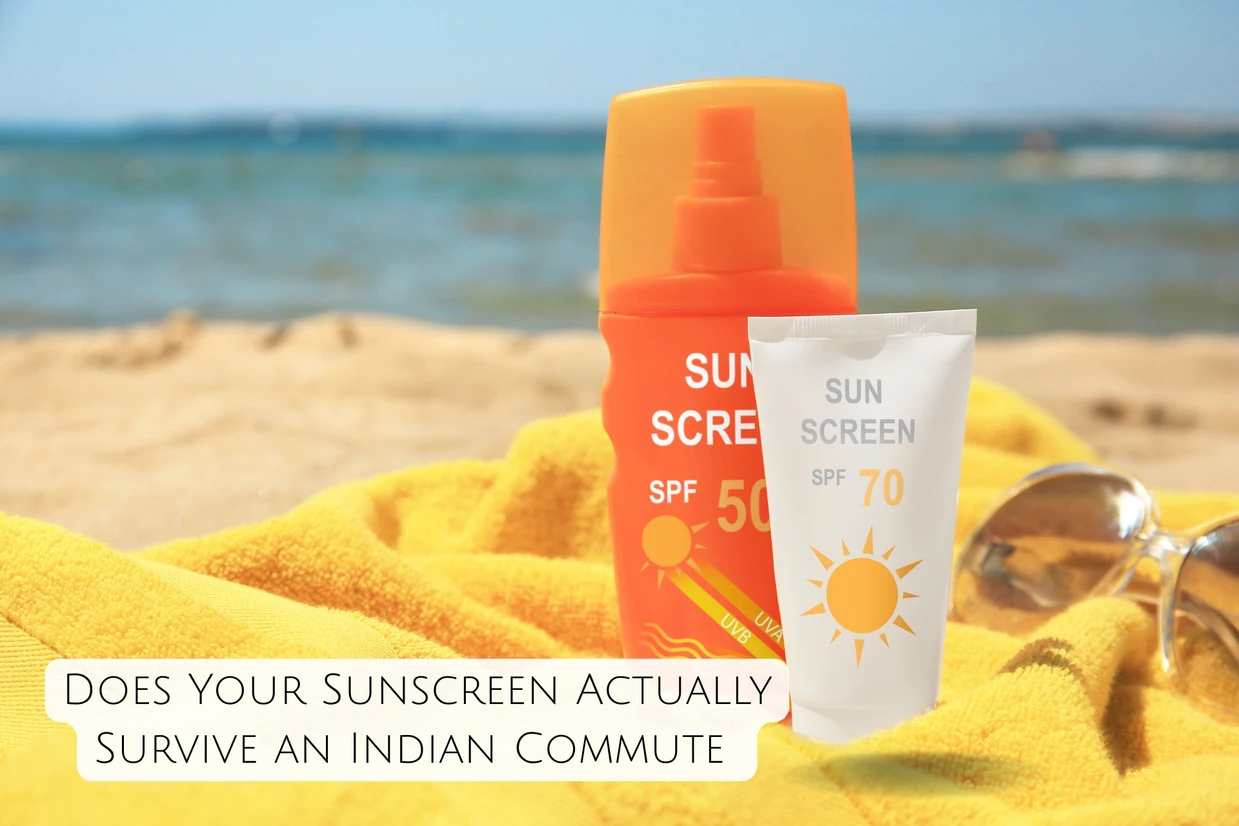
Does Your Sunscreen Actually Survive an Indian Commute? Sweat-Resistant Sunscreen, PA Ratings, and Why a UK Formula Melts at 90% Humidity
It's 9:15 a.m. You applied sunscreen at 8:30 like a responsible adult. Then came the walk to the metro, the wait for the auto, the helmet, the crowd, the sun bouncing off every glass building in sight. By the time you reach office and catch your reflection in the lift, your face is a glossy mix of sweat, sebum, and whatever's left of that SPF 50.
So here's the uncomfortable question: was any of it still working? A genuinely sweat-resistant sunscreen exists — but most of what's sold in India, especially formulas designed for London drizzle rather than Chennai steam, quietly gives up somewhere between your front door and your desk. Let's talk about why, and how to pick one that actually finishes the commute with you.
QUICK ANSWER Most sunscreens don't fully survive a sweaty Indian commute. For real-world protection, choose a sweat-resistant sunscreen labelled “water resistant (40 or 80 minutes)” with PA++++ UVA protection, in a lightweight gel or watery texture — typically Asian-formulated — and reapply by early afternoon. Heavier European creams often slide off in high humidity.
What “Sweat-Resistant Sunscreen” Actually Means on the Label:
First, a myth to bury: no sunscreen is sweat-proof. Regulators in the US and EU banned that word years ago because it overpromises. What you'll see instead is “water resistant (40 minutes)” or “water resistant (80 minutes)” — and those numbers mean something specific.
How water resistance is actually tested:
In the standard test, volunteers apply the sunscreen, sit in a whirlpool bath for timed intervals, and then have their SPF re-measured. If the product still delivers its labelled SPF after 40 or 80 minutes of water immersion, it earns the claim. Sweat resistance is assumed to track water resistance, since sweat is mostly water with salt and oils mixed in.
Useful? Yes. But notice what the test doesn't include: friction, sebum, 38-degree heat, and a handkerchief.
Why the lab test flatters your commute:
A whirlpool bath doesn't rub. Your helmet strap does. Your mask does. Your habit of dabbing your forehead every ten minutes absolutely does. Each wipe removes sunscreen film mechanically — something no water-resistance rating accounts for. Add sebum, which Indian skin in humid weather produces generously and which actively breaks down sunscreen films, and a “40-minute” rating can translate to far less on a real face on a real Tuesday.
Decoding the labels: water resistant vs. sweat resistant vs. sport
Brands scatter these terms around loosely, so a quick translation guide:
- “Water resistant (40/80 min)” The only claim backed by a standardised immersion test. Trust the number in brackets more than any adjective on the front.
- “Sweat resistant” Usually marketing shorthand for the same water-resistance test, sometimes for nothing at all. If there's no minute rating anywhere on the pack, treat the claim as decorative.
- “Sport” or “active” A vibe, not a regulation. Some sport formulas are genuinely tenacious; others are ordinary sunscreens in a sportier bottle. Check for the water-resistance minutes and PA rating underneath the branding.
- “Dermatologist tested” Means a dermatologist was involved in testing — it says nothing about what the test found. Ignore it when comparing protection.
PA Ratings Decoded: The Number That Matters Most for Indian Skin:
SPF gets all the attention, but SPF only measures UVB — the burning rays. Indian skin rarely burns. What it does, enthusiastically, is tan and pigment. That's UVA territory, and UVA protection is what the PA rating measures.
PA is based on a lab measure called PPD — persistent pigment darkening — which is almost comically relevant here: it literally measures how much skin darkens under UVA. The scale runs from PA+ to PA++++:
|
PA rating |
UVA protection (PPD) |
What it means for pigmentation-prone skin |
|
PA+ |
PPD 2–4 |
Minimal. Fine for a winter evening indoors, not for an Indian commute. |
|
PA++ |
PPD 4–8 |
Modest protection. Tanning and PIH will still creep in with daily exposure. |
|
PA+++ |
PPD 8–16 |
Good for everyday use — the acceptable minimum if you're outdoors daily. |
|
PA++++ |
PPD 16+ |
The standard to aim for. Best defence against tanning, melasma, and dark spots. |
Here's the honest take: if your sunscreen bottle doesn't mention a PA rating or “broad spectrum” at all — and plenty of older Indian pharmacy staples don't — you're buying burn protection for skin that doesn't burn, and skipping the protection it actually needs. For melanin-rich skin fighting tanning and dark spots, PA++++ isn't a luxury spec. It's the point.
Why a UK-Formulated SPF Behaves Differently in 90% Humidity?
A sunscreen is not just filters in a bottle. It's a film — an emulsion engineered to spread, set, and stay put on skin. And films are designed around a target climate.
Built for drizzle, not for steam:
European formulas are typically richer creams: more emollients, heavier film formers, textures that feel comforting at 15 degrees with dry air. Apply that same cream in Mumbai in June and the physics change. Your skin never stops producing sweat and oil, the film never fully sets, and the whole thing stays semi-liquid — which is why it migrates into your eyes, pills under your fingers, and shines like a glazed doughnut by 11 a.m.
The Asian-formulation difference:
Japanese and Korean sunscreens grew up in climates much closer to ours — hot, humid summers where cosmetically elegant sun protection is a daily necessity, not a beach product. The result: watery gels and milky essences that set fast into a dry-touch film, alcohol-based systems that flash off quickly, and technologies designed to hold up under sweat. Many are also built around newer UV filters that deliver PA++++ without the thick, chalky payload.
And then there's the white cast problem:
Most UK and US mineral formulas were frankly not developed with Fitzpatrick IV and V skin in mind. Zinc-heavy creams that look “invisible” on pale skin can leave a grey, ashy film on wheatish and dusky tones — which is the single biggest reason people here apply a fraction of the required amount, or quietly stop using sunscreen for humid weather altogether. An elegant texture isn't vanity. It's compliance.
The Indian Commute Stress Test: Where Sunscreens Fail:
Map your morning against what sunscreen films hate most, and the problem becomes obvious:
- The helmet and mask zone. Constant strap friction along the jaw and forehead physically scrubs product off — which is exactly where many riders notice patchy darkening over time.
- The AC-to-furnace cycle. Cold metro coach, blazing platform, cold office. Each swing triggers a fresh sweat response that stresses the film before it can re-set.
- The forehead wipe. Every dab with a handkerchief or tissue removes sunscreen mechanically. Blot gently if you must; don't drag.
- The quantity shortfall. Protection is tested at 2 mg per square centimetre — roughly two full finger-lengths for the face and neck. Most people apply a third of that, which slashes an SPF 50 into something closer to single digits.
- The no-reapplication reality. One 8:30 a.m. application cannot protect you at 5:30 p.m. It was never designed to, sweat or no sweat.
How to Pick a Sunscreen That Survives the Ride:
Your checklist, in order of importance:
- PA++++ and SPF 50, broad spectrum. Non-negotiable for daily outdoor exposure on pigmentation-prone skin.
- “Water resistant” printed on the pack. Prefer 80 minutes if you ride a two-wheeler or walk a long last mile.
- Gel, watery, or milk texture. If it feels like body lotion going on, it will feel like soup by mid-morning. Light textures set into tougher films in humidity.
- No white cast on your actual skin tone. Test on your jawline in daylight, not the back of your hand under shop lighting.
- A realistic reapplication plan. A sunscreen stick or spray in your bag for a 1 p.m. top-up beats a heroic single morning coat. Powder SPFs work over makeup in a pinch, though they're a supplement, not a substitute.
The realistic reapplication playbook for office-goers:
“Reapply every two hours” is textbook advice written for beach days. Here's a version that survives contact with an actual Indian workday:
- 8:30 a.m. — the base coat. Two finger-lengths across face and neck, applied on dry skin ten minutes before you step out so the film sets before the sweating starts. Don't forget ears and the back of the neck if you ride.
- Arrival — blot, don't wipe. Press a tissue flat against the skin to lift sweat and oil. Dragging removes film; pressing mostly doesn't.
- 1:00 p.m. — the lunch top-up. One proper reapplication before you step out for lunch or an afternoon meeting. A stick or spray makes this a 30-second job at your desk; over makeup, a cushion or powder SPF keeps it civilised.
- Evening commute — judgement call. Heading home before 4:30 in peak summer, or facing a long west-facing ride? Top up. Leaving after sunset? Skip it and go wash your face.
Two honest applications a day, done properly, will outperform four theoretical ones you never actually do. Build the habit around your commute timings, not around a rulebook.
What We Import at Kiwla — and Why It's Mostly Asian Sunscreen:
Full disclosure of our bias: when we curate sunscreens at Kiwla, the shortlist skews heavily toward Korean and Japanese formulas, with a few standout UK and US picks that have proven themselves in humid-climate testing. Not because of trend-chasing — because texture failure is the number one reason customers tell us they abandoned sunscreen, and Asian formulation science has simply solved that problem better for weather like ours.
What we look for before a sunscreen makes it to the store: PA++++ with a stated water-resistance claim, a finish that photographs clean on medium-to-deep Indian skin tones, and a texture light enough that reapplying at lunch doesn't feel like punishment. If a formula can't clear those three bars, it doesn't matter how good the reviews from Manchester are.
Browse the sun care range on Kiwla if you want options pre-filtered for exactly this — humid-climate performance first, everything else second.
Quick Answers Before You Go:
Does sweating mean my sunscreen has stopped working? Not instantly. A good water-resistant film survives light sweating, but heavy dripping plus wiping means protection is fading — reapply within the hour.
Gel vs cream sunscreen for oily Indian skin? Gel or watery formulas, almost every time. They set faster, shine less, and are far likelier to still be on your face at noon.
Is SPF 50 PA++++ overkill for a 30-minute commute? No. UVA penetrates cloud, glass, and haze, and commute exposure compounds daily. The “overkill” costs you nothing; the underkill costs you dark spots.
Do I need sunscreen inside an office? If you sit near a window, yes — UVA passes through glass. Deep inside an interior cubicle, your morning application has you covered.
The Bottom Line
A sunscreen that survives an Indian commute is a specific product, not a generic one: SPF 50, PA++++, water resistant, in a light gel or milk texture that sets fast and disappears on brown skin — applied in real quantity and topped up once by afternoon.
The most protective sunscreen in the world is the one that's still on your face at 6 p.m. — and that you'll willingly apply again tomorrow. Judge every bottle by the commute, not the brochure. If it can't handle your ride to work, its lab numbers are trivia.
Recent Posts
-

Infant & Toddler Nutrition: A Guide to Feeding Stages, Essential Nutrients & Introducing Foods
Somewhere between the 2 AM feeds and the day your baby flings mashed banana across the kitchen wall,
-

Hard Water Hair Damage: How Indian City Water Quietly Undoes Your ₹3,000 Imported Shampoo — and the Chelating Ingredients That Fix It
You know the pattern. A new imported shampoo arrives — the one that made your hair feel like silk on
-
Does Your Sunscreen Actually Survive an Indian Commute? Sweat-Resistant Sunscreen, PA Ratings, and Why a UK Formula Melts at 90% Humidity
It's 9:15 a.m. You applied sunscreen at 8:30 like a responsible adult. Then came the walk to the met